
Design Your Work & Life Through Competencies: A GROW Roadmap for Future‑Ready Growth
- Design & Grow Catalyst

- Aug 1, 2025
- 4 min read
Updated: Aug 29, 2025
Modern careers no longer follow a straight line—they are shaped by what you know, how you work, and the value you create in real contexts. Employers consistently cite gaps not only in technical depth—such as AI, data analytics, and digital systems—but also in human capabilities like leadership, adaptability, and critical thinking. Competencies bridge these dimensions: they show how knowledge and skills come alive in action. Grow them with intention, and you build agility, resilience, and lasting career mobility. (World Economic Forum, 2023; McKinsey, 2023; SHRM, 2024.)
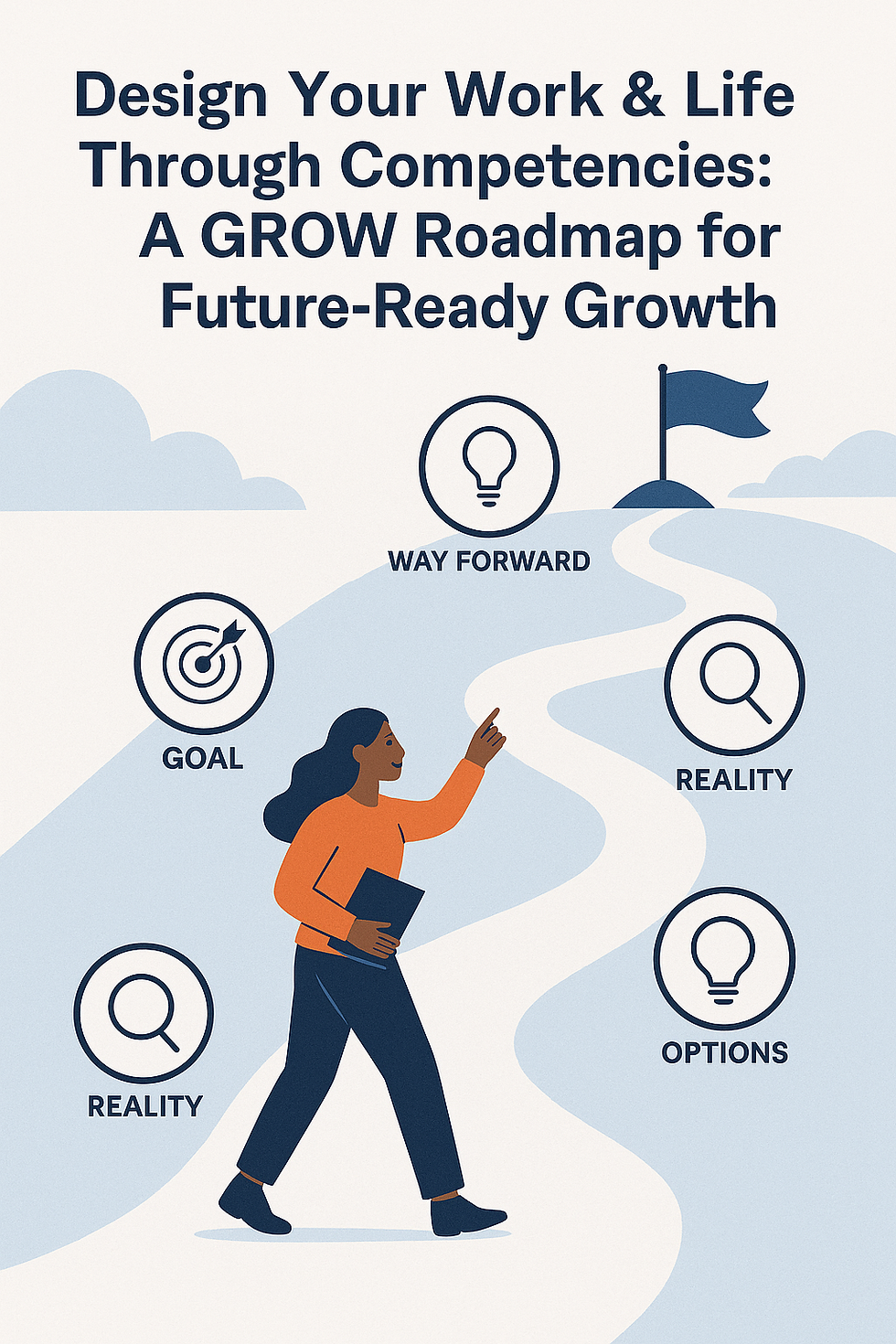
Designing Your Life (DYL) encourages curiosity, creative reframing, and low-risk experiments to explore multiple career futures. You don’t choose one fixed path—you design pathways through iterative action. (Burnett & Evans, 2016.) The GROW framework—Goal, Reality, Options, Way Forward—adds structure: it transforms insight into progress through focused reflection and clear commitments. Together, they help you design, act, and adapt with purpose.
Three Lenses to Understand Your Competencies
Competencies reveal the difference between having skills and applying them effectively. They fall into three meaningful zones:
1. Signature Competencies – Your Core Strengths
These are well-developed capabilities that define how you operate. They’re reliable, recognized, and often the first things people count on you for. Think of them as your anchor strengths—assets you should use strategically and keep sharp.
2. Emerging Competencies – Your Growth Edge
Here lie the skills that show promise but aren’t yet second nature. They might be newly learned or lightly practiced, offering room for growth. These are your investment zones—develop them to increase range and adaptability.
3. Over-applied Competencies – When Strengths Tip Over
Any strength can become a liability when used in excess or without context. Over-applied influence may come across as dominance; overused precision can slow progress. Calibrate them to maintain balance and effectiveness.
Recognizing where your competencies fall helps you lead with confidence, develop where it matters, and avoid derailers.
From Awareness to Action: GROW × DYL in Motion
Here’s how to turn reflection into measurable growth:
1. Goal – Define a Competency Challenge That Matters
Replace vague questions with targeted prompts:
How can I enhance strategic thinking while maintaining agility in fast-changing projects?
What would it take to strengthen collaboration without losing accountability?
Keep goals short-term (90 days) for traction, while linking them to long-term aspirations.
2. Reality – Take Inventory of Your Competency Landscape
Assess where you stand today. Map Signature, Emerging, and Over-applied Competencies. Validate your view with:
Examples from recent work
Feedback from peers or supervisors
Evidence of results and impact
Then, compare your profile against industry benchmarks and trends to identify gaps. (Lightcast, 2024; LinkedIn Learning, 2024.)
🔗 Check out this Tool: Competencies Profiler
3. Options – Experiment with Learning Paths and Stretch Assignments
Think beyond formal training—design quick, low-risk experiments:
Facilitate a team workshop to strengthen influence skills
Take ownership of a mini-project to build systems thinking
Pair technical learning (e.g., automation basics) with adaptive skills like decision-making under pressure
Run these as 4–6 week sprints so you can test, reflect, and iterate.
4. Way Forward – Lock in Commitments and Review Progress
Translate options into specific actions with timelines:
By next month: Lead two client debrief sessions to practice concise communication
Complete scenario-planning exercise to improve strategic agility
Build in checkpoints:
What moved forward?
What patterns did I notice?
What needs adjustment?
Document progress to make competencies visible in portfolios, reviews, and performance narratives. (NACE, 2024; SHRM, 2024.)
Competency Development Tracker (Starter Template)
Competency Zone | Current Level | Proof Points | Development Focus | Paired Strength | Next Step | Review Date |
Signature: Client Influence | Strong | Repeat stakeholder buy-in | Expand to executive presence | Analytical Thinking | Deliver quarterly board briefing | Aug 15 |
Emerging: Systems Thinking | Moderate | Process mapping in one project | Practice in cross-team contexts | Collaboration | Join enterprise design initiative | Aug 15 |
Over-applied: Detail Orientation | High | Past audits flagged as too slow | Learn prioritization techniques | Growth Mindset | Time-box review tasks | Aug 15 |
Update regularly to keep growth intentional.
For Leaders, Educators & Workforce Strategists
Align learning assets to both technical depth and adaptive capabilities.
Use real work outputs—design briefs, reports, dashboards—plus feedback as competency evidence.
Stage pathways: Awareness → Guided Practice → Independent Execution → Context Transfer.
Embed reflection checkpoints and forward plans in every development cycle.
Your 2-Week Challenge: Select one Signature Competency to leverage, one Emerging Competency to strengthen, and one Over-applied Competency to recalibrate. Prototype, reflect, iterate—and repeat.
A career isn’t a fixed track—it’s a design challenge. Competencies make the design real: they show how you work, grow, and lead in action. (Burnett & Evans, 2016; Whitmore, 2017.)
References
Burnett, B., & Evans, D. (2016). Designing your life: How to build a well-lived, joyful life. Knopf.
Léon, C. T. (2025). Life sprint: Designing your life with agile momentum, from https://www.amazon.com/dp/B0FP2RTB4J
LinkedIn Learning. (2024). Competency development and future skills. https://www.linkedin.com/learning
Lightcast. (2024). Industry skills benchmarks and workforce trends. https://www.lightcast.io
McKinsey & Company. (2023). The future of work: Reskilling and workforce transformation. https://www.mckinsey.com
National Association of Colleges and Employers (NACE). (2024). Career readiness competencies and development. https://www.naceweb.org
SHRM. (2024). Building competencies for the evolving workplace. Society for Human Resource Management. https://www.shrm.org
Whitmore, J. (2017). Coaching for performance: The principles and practice of coaching and leadership (5th ed.). Nicholas Brealey Publishing.
World Economic Forum. (2023). Future of jobs report 2023. https://www.weforum.org/reports/future-of-jobs-report-2023


Comments