
Discover Your Strengths: The 8 Smartnesses and Why They Matter
- Design & Grow Catalyst

- Jul 2, 2025
- 3 min read
Updated: Aug 9, 2025
When people talk about “playing to your strengths,” they often think of things like public speaking, leadership, or tech skills. But strengths aren’t just about tasks. They’re about how you think, what energizes you, and how you naturally solve problems.
Understanding your strengths gives you:
Clarity about your personal and career direction
Confidence in how you learn and relate to others
Freedom to focus on what you do best
In this post, we’ll explore different kinds of strengths—and introduce a simple, powerful tool you can use today: the 8 Smartnesses.
Types of Strengths
Before diving into the 8 Smartnesses, here’s a quick look at the different ways strengths show up in our lives:
Skill-based strengths – Abilities you’ve developed through practice (e.g., organizing, coding, writing)
Personality/Character-based strengths – Traits that reflect how you engage with people or tasks (e.g., being reliable, empathetic, creative)
Values-driven strengths – Strengths that align with what matters most to you (e.g., justice, service, integrity)
Interest-driven strengths – Activities you feel drawn to and energized by
Thinking and learning strengths – How your mind naturally works
And this last category is where the 8 Smartnesses come in.
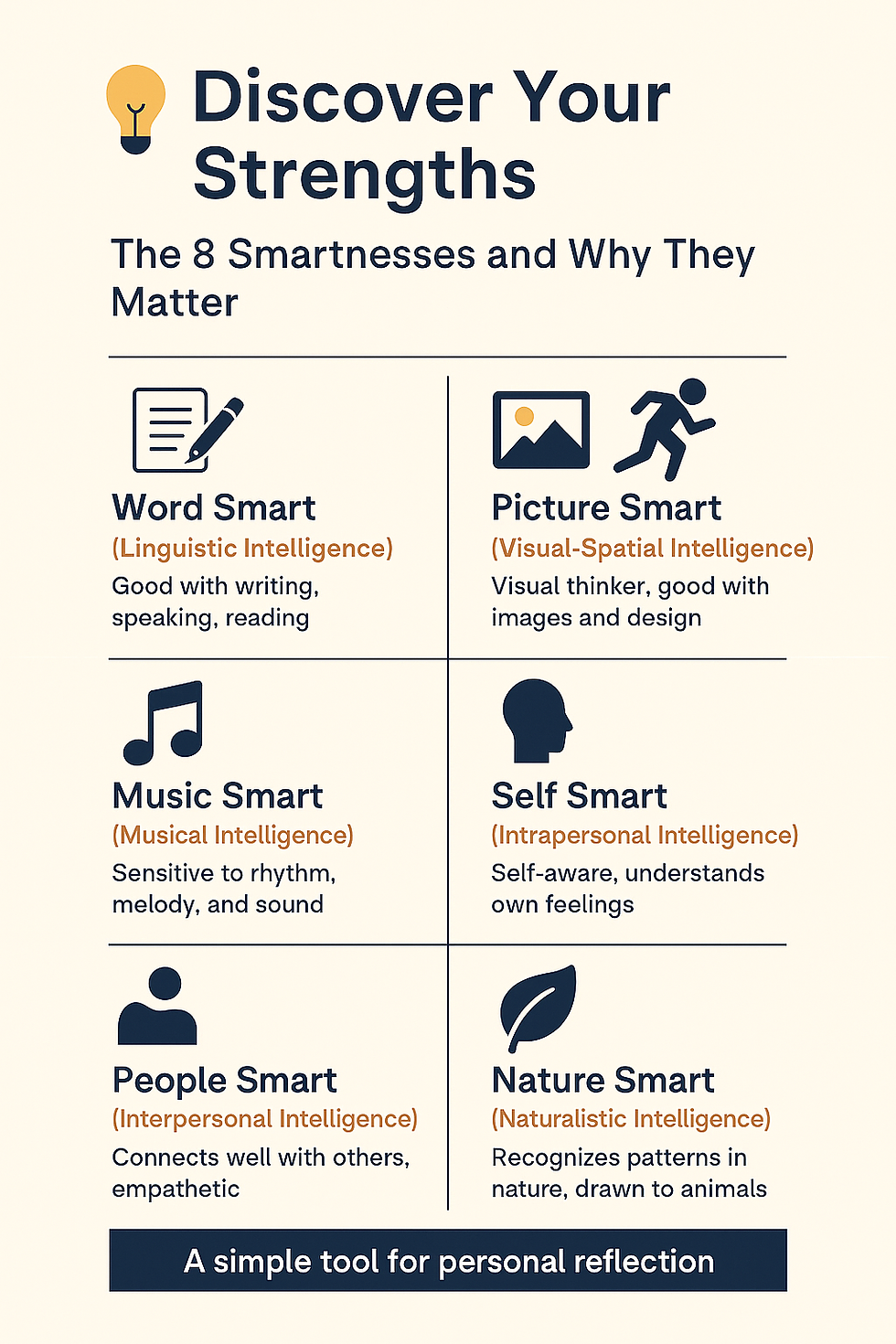
The 8 Smartnesses (a.k.a. Multiple Intelligences)
The 8 Smartnesses come from the work of Harvard professor Howard Gardner, who proposed that people are smart in many different ways—not just the traditional “book smart” kind.
This model is incredibly useful for self-awareness, learning, work, and life. It’s simple to understand, easy to apply, and empowering at any age.
Let’s look at each one.
Word Smart (Linguistic Intelligence)
You love words—writing, reading, journaling, speaking, or storytelling. You express yourself clearly and enjoy learning through language.
Example: You enjoy writing blog posts, crafting speeches, or reading novels.
Logic Smart (Logical-Mathematical Intelligence)
You’re great with numbers, systems, puzzles, or step-by-step reasoning. You often ask “why” or “how” things work.
Example: You enjoy problem-solving, programming, or playing strategy games.
Picture Smart (Visual-Spatial Intelligence)
You think in images and understand space, color, and layout well. You might be good at art, maps, diagrams, or visual design.
Example: You enjoy drawing, interior decorating, photography, or graphic design.
Body Smart (Bodily-Kinesthetic Intelligence)
You learn best by doing. You’re in tune with your body and might enjoy sports, dance, or working with your hands.
Example: You enjoy building things, playing instruments, or physical performance.
Music Smart (Musical Intelligence)
You notice sound patterns, rhythms, and melodies. Music helps you learn and express emotions.
Example: You enjoy singing, playing an instrument, or listening deeply to music.
People Smart (Interpersonal Intelligence)
You’re sensitive to people’s moods and motivations. You enjoy collaboration, communication, and helping others.
Example: You enjoy leading teams, mentoring, teaching, or counseling.
Self Smart (Intrapersonal Intelligence)
You’re reflective and self-aware. You understand your own goals, emotions, and values.
Example: You enjoy journaling, setting goals, or exploring your inner world.
Nature Smart (Naturalistic Intelligence)
You’re tuned in to nature, patterns, and the environment. You notice details others miss in the natural world.
Example: You enjoy gardening, hiking, or working with animals and the outdoors.
Why the 8 Smartnesses Are So Useful
This framework is:
Simple to understand—No tests needed. Just reflect.
Applicable across life—From school to work to personal growth.
Empowering—Helps you value intelligence beyond academic scores.
You don’t need to “have all 8.” Most people have 2–3 dominant smartnesses, and the rest can be developed over time.
🔗 Check out the Strengths Reflection Tool: Strengths Profiling
How to Reflect on Your Smartnesses
Here’s a quick activity to try:
Review the 8 smartnesses above.
Ask yourself: Which 2–3 sound most like me?
Reflect: When have I used these strengths in real life?
Consider: How can I use them more in how I work, learn, and relate to others?
This is a great exercise to do with friends, students, co-workers—or just for your own journaling time.
Final Thoughts
There are many ways to be smart—and many kinds of strengths. The 8 Smartnesses help us see that intelligence isn’t one-size-fits-all.
So whether you’re Word Smart, People Smart, or Nature Smart, don’t try to fit into someone else’s mold. Start from your own wiring.
Embrace how you’re smart. That’s where confidence, clarity, and contribution begin.
References
Gardner, H. (1993). Multiple intelligences: The theory in practice. New York, NY: Basic Books.
Gardner, H. (2011). Frames of mind: The theory of multiple intelligences (10th anniversary ed.). New York, NY: Basic Books.
Clifton, D. O., & Anderson, E. (2001). StrengthsQuest: Discover and develop your strengths in academics, career, and beyond. New York, NY: The Gallup Organization.
Rath, T. (2007). StrengthsFinder 2.0. New York, NY: Gallup Press.
Seligman, M. E. P., & Peterson, C. (2004). Character strengths and virtues: A handbook and classification. New York, NY: Oxford University Press.
Amabile, T. M. (1996). Creativity in context: Update to the social psychology of creativity. Boulder, CO: Westview Press.
Robinson, K. (2009). The element: How finding your passion changes everything. New York, NY: Viking.


Comments