
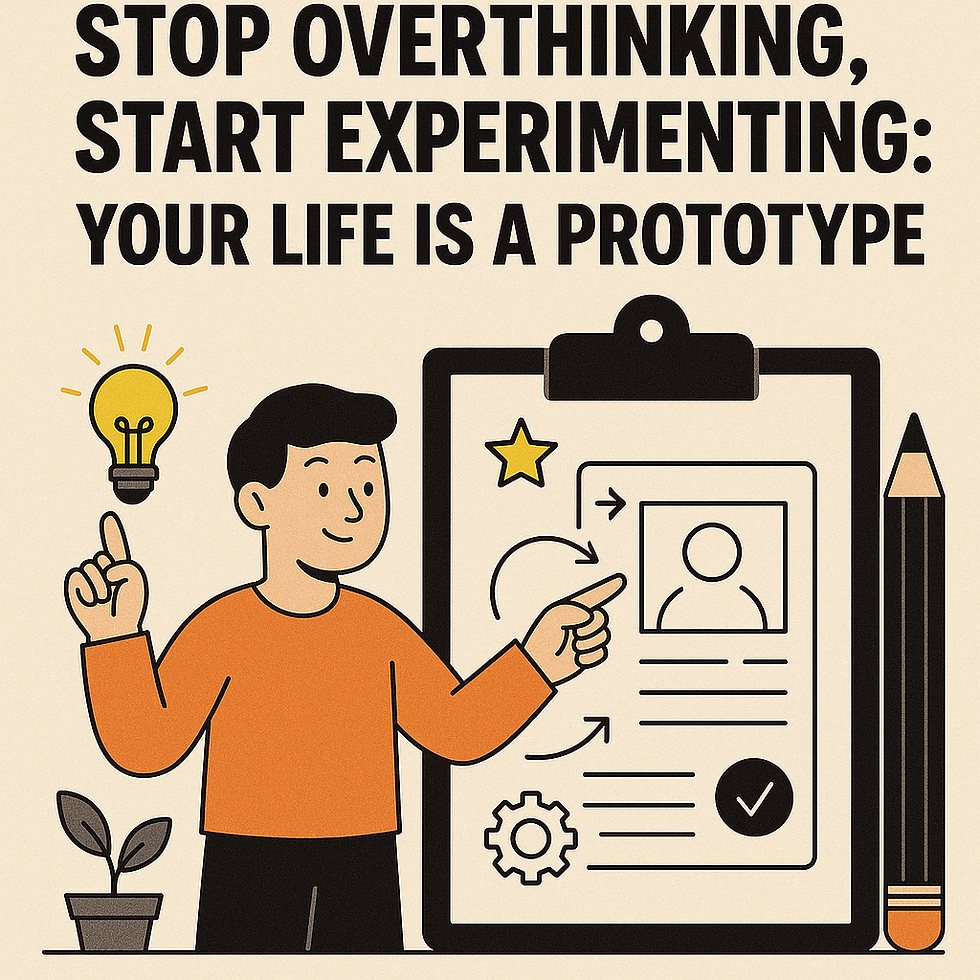
Stop Overthinking, Start Experimenting: Your Life Is a Prototype
- Design & Grow Catalyst

- Aug 9, 2025
- 3 min read
Updated: Aug 29, 2025
Planning can only take you so far. At some point, the real magic happens when you stop analyzing and start trying. Life design isn’t about finding the perfect answer in your head—it’s about discovering what works by doing. That’s where prototyping comes in.
Instead of making massive, high-risk decisions, you take small, smart steps to test your ideas in the real world. These experiments give you feedback, spark new insights, and reduce the fear of making a “wrong” move. Every test is a chance to learn more about what fits you—and what doesn’t—without betting everything on one big leap.
You can’t think your way into a new life—you have to act your way into it. That means trying, learning, adjusting, and trying again. It’s progress through action, not perfection through planning.
Why Prototyping Matters
Prototyping reduces fear, lowers risk, and turns uncertainty into opportunity. It gives you a practical way to test an idea before committing fully.
Each small step helps you:
Explore paths without heavy investment
Build confidence through hands-on experience
Discover surprises you didn’t anticipate
Expand your network and open new doors
Make big changes feel manageable
How to Start Prototyping
Think of prototyping as experiments in real life—quick, scrappy, and designed to teach you something valuable.
Have Conversations
Reach out to people already doing what you’re curious about.
These informal interviews can reveal the reality behind the title, highlight challenges, and spark fresh ideas you might never find online.
Try Micro-Experiments
Instead of overhauling your life, start small:
Wondering about a career in hospitality? Host a themed dinner at home.
Curious about writing? Commit to 10 minutes a day for a week.
Thinking about entrepreneurship? Sketch a basic business concept or pitch deck.
These little steps let you feel what the work is actually like.
Immerse Yourself
Shadow someone for a day or volunteer in a role that interests you.
Real-world exposure often gives you more clarity than hours of research.
Sample New Skills
Take a weekend workshop or short online course.
Quick, low-pressure learning lets you explore without major commitment.
Test, Learn, Adjust
Prototyping isn’t the finish line—it’s the starting point for insight.
After each experiment, pause and reflect:
What energized me?
What drained me?
What surprised me?
What does this mean for my next step?
Testing helps you decide whether to pivot, persist, or expand on an idea. Every result—good or bad—is valuable because it moves you forward with real knowledge, not assumptions.
Stay Flexible and Curious
Life design isn’t about perfect plans—it’s about continuous iteration.
You might circle back, tweak ideas, or try new ones. That’s not failure—it’s growth in action.
Each prototype is a chance to explore possibilities without pressure and discover paths you couldn’t imagine before.
Your Next Step
Start small. Stay curious. Act your way into clarity. Each experiment, conversation, or skill you try brings you closer to a life that truly works for you.
Ready to make your ideas real?
🔗 Check out this Tool: Life Sprint Planner
👉 Download the Odyssey Planner Workbook for templates, reflection prompts, and practical tools to guide your prototyping journey.
Key Reminder:
Life design isn’t about a single perfect choice—it’s about experimenting, learning, and creating a future that evolves with you.
References
Burnett, B., & Evans, D. (2016). Designing your life: How to build a well-lived, joyful life. New York, NY: Alfred A. Knopf.
Léon, C. T. (2025). Life sprint: Designing your life with agile momentum, from https://www.amazon.com/dp/B0FP2RTB4J
Burnett, B., & Evans, D. (2021). Designing your new work life: How to thrive and change and find happiness—and a new freedom—at work. New York, NY: Alfred A. Knopf.
Geerthika, G. (n.d.). You can’t think your way into a new life—you have to act your way into it. [Inspirational Quote].
IDEO. (2015). The Field Guide to Human-Centered Design. IDEO.org.
Stanford Life Design Lab. (n.d.). Designing Your Life resources. Stanford University. Retrieved from https://lifedesignlab.stanford.edu/


Comments